
A pro photographer and guest photos: how to make them work together
The photographer covers the official essentials. Guests fill the missing angles. How to organize the two without confusion.

Émile Leroux
4 min read
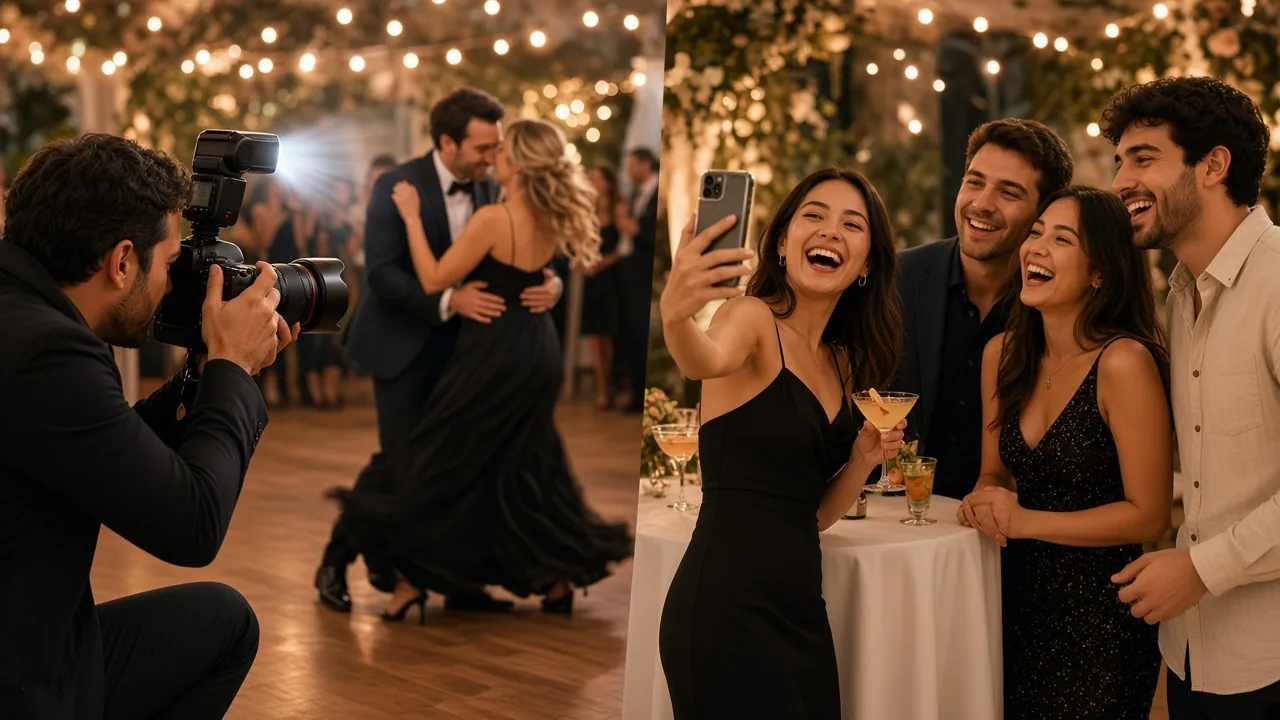
"We already have a photographer. Does a photo QR still make sense?"
Yes, if you explain each person's role before the party.
In short
The photographer builds the official story. Guests add the angles, the tables, and the end of the evening. The two can coexist without stepping on each other.
What the photographer sees (and what they do not cover)
A good photographer covers the key moments, the portraits, the ceremony, the group portraits. They cannot be everywhere at once. They do not stay at every table. They do not necessarily film the dance floor at 1 a.m.
Guests are already there with their phone. They capture:
- Table conversations.
- Backstage moments, and the arrivals.
- Improvised dances.
- Details the pro deliberately left aside.
Together, you get wider coverage.
Step 1: align expectations before the day
Talk to the photographer a week before. A five minute conversation is enough.
Points to clarify:
- You are also collecting guest photos through a QR code for wedding photos.
- The guest gallery adds to their work. It does not replace it.
- You are not asking them to manage the guest gallery.
- You can show them the live wall if they are curious, with no obligation.
Serious pros appreciate clarity. What they do not like is the surprise, or the feeling of being replaced.
Step 2: explain the pair to the guests
One sentence on the mic settles the confusion:
"[First name] is capturing the official photos. On your side, scan the QR to add your photos to the shared gallery. Both stay."
Without that sentence, some people believe they should stop taking photos. Others believe the QR replaces the pro. Both misunderstandings break participation. When guests scan, at the meal rather than during the vows: scanning the photo QR during a wedding.
Step 3: separate the uses
Keep a simple logic after the event:
- Official album or prints: the photographer's work.
- Collective gallery, live wall, table memories: guest uploads.
- ZIP of the guest originals: the host archive, kept apart.
Mixing everything into one folder the same evening creates chaos. Two sources, two folders.
Step 4: use the QR where the pro is less present
The QR pays off most in the zones and moments the photographer covers less densely:
- Cocktail and staggered arrivals.
- Tables during the meal.
- The end of the dance floor.
- The next day's brunch, if you have one.
You are not asking guests to redo the couple portraits. You are asking for what they already have on their phone. The object on the table: a wedding sign for the photo QR.
Step 5: respect each person's work when you share
When you share afterward:
- Credit the photographer on the official images.
- Do not present the guest gallery as "the wedding photos," in the singular, if the pro is also delivering.
- Say "the guests' photos" or "the collective gallery" instead.
Precision protects the relationship with the pro and makes the value of each source clear.
What not to do
- Surprise the photographer on the day with a live wall you never mentioned.
- Ask the pro to manage the QR on top of their coverage.
- Let guests believe they should stop taking out their phone.
- Merge the pro's RAW and the guests' JPEG with no sort.
- Publicly compare who has the most beautiful photos.
In summary
A pro photographer and a guest gallery answer two different needs. One delivers a careful story. The other captures the human density of the room.
Brief the pro, announce the pair out loud, separate the archives, place the QR where phones are already active.
Unlocking the event is on pricing.